

- .Aimee Willett, 26, was diagnosed with cervical cancer at her first smear test
- .Is now calling for the national smear test age to be lowered from 25
- .Health officials say screening women under 25 does 'more harm than good'
- .Miss Willett has now made a bucket list of the things she wants to do
- .Plans to marry her boyfriend and give her boys the best Christmas ever
A mother-of-two with terminal cancer is spending her last months campaigning to lower the national smear test age after her first examination at 25 found she had cancer.
Aimee Willett is facing what she fears will be her last Christmas with sons Charlie and Kaleb and fiance Michael Bond.
The 26-year-old went for her first smear test last December, after turning 25 - the age at which NHS screening currently starts.
The results changed Miss Willett's life.
Doctors gave her the devastating news that she had cancerous cells. In June she faced a second blow, as experts said another, inoperable tumour had been found.

Aimee Willett, 26 (centre) is facing a heartbreaking Christmas with her two young sons Charlie, eight (right) and Kaleb, three (left) after her first smear test at 25 found incurable cancer


Miss Willett (left) is now calling for the national smear test age to be lowered. She has made a bucket list of things she wants to do before she dies, including taking her boys (right) to Disneyland Paris
Her cancer was diagnosed as terminal when the original tumour in her cervix spread to other areas of her body.
She was working as a waitress, but was forced to give up work when she fell ill.
She has now undergone surgery, chemotherapy and radiotherapy but has been warned she is unlikely to survive until 2016.
She said her case highlights the need for the national smear test age to be lowered.
But the Government said screening women under the age of 25 can do more harm than good.
She said: 'I am bitter about it and I would like to see the age lowered.
'I think 25 is too old - especially if a girl has had a child at a young age.
'The biggest thing for me now is for people to be more aware.
'If you experience anything that's not normal, go to your doctor and get it checked out and when you get a letter asking you to go for a smear test make an appointment straight away and keep it.
'I always thought it would never happen to me because I was young, but cancer doesn't pick an age group.'
A report released this week found fewer women under 30 present themselves for smear tests than older women.
Figures from the Health and Social Care Information Centre found that number of women aged 25 to 29 screened last year was considerably lower than those in older age groups.
Only 63 per cent of women aged 25 to 29 were screened by 31 March 2014, compared to 82 per cent of women aged 50 to 54.
A majority (93 per cent) of young women screened had a negative result, with just over one per cent shown to have a 'high-grade abnormality', which could lead to cervical cancer.
Miss Willett, of Sittingbourne, Kent, has now made a bucket list of all the things she wants to do before she dies.
Top is to marry her fiance Michael Bond, 26, and next is to give her boys Charlie, eight, and Kaleb, three, the best Christmas ever.
She added: 'We're taking the kids to Lapland UK as a surprise and we plan to spend Christmas Day at home, just the four of us, with the kids playing with their toys.
'Getting married might be a bit difficult due to money. Other things on my list include seeing the Eiffel Tower light show and Disneyland Paris with the boys.
'I'd also like to take part in Race for Life so they can see me do it whether it's walking, crawling or being carried across the line.'
The Advisory Committee on Cervical Cancer Screening advised the NHS Cervical Screening Programme to raise the starting age for cervical screening from 20 to 25 in 2003.
Professor Julietta Patnick, director of the NHS Cancer Screening Programmes, managed by Public Health England (PHE), explained this decision was made because the evidence shows testing women under the age of 25 'may do more harm than good.'
She said: 'Cervical cancer in women under the age of 25 is very rare.
'Younger women often undergo natural and harmless changes in the cervix that screening would identify as cervical abnormalities, and in most cases these abnormalities resolve themselves without any need for treatment.
'Evidence has shown that screening women under the age of 25 may do more harm than good as it can lead to unnecessary and harmful investigations and treatments which could have an adverse effect on their future childbearing.
'In women under 25, therefore, this risk outweighs any benefit.'
Professor Patnick said the introduction of vaccines for teenagers is reducing the rates of cervical cancer in young women.
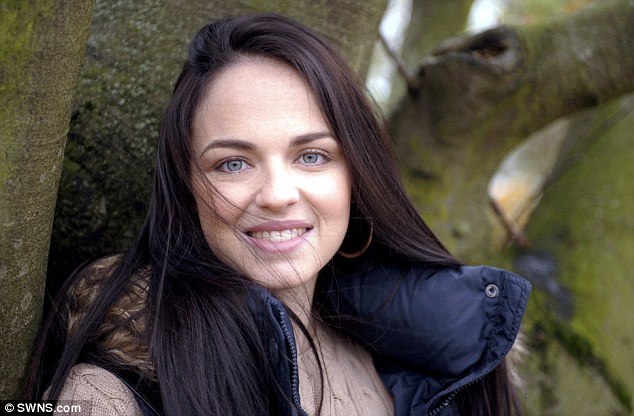
Miss Willett is now hoping to give her sons the 'best Christmas ever' and also hopes to marry her fiance
She added: 'Almost all cervical cancers are caused by the human papillomavirus (HPV) - a very common sexually transmitted infection which is linked to the development of the disease.
'Since 2008, girls aged 12 and 13 have been offered the HPV vaccination, which immunises them against the most high risk strains of HPV.
'To start with, girls up to 18 were also vaccinated so the first girls to be vaccinated will be coming into the cervical screening programme next year (2015) as they are 23 and 24 now.
'This vaccine will reduce the already low rates of cervical cancer in these young women and mean they will be protected for many years.'
The Department of Health echoed that screening for women under 25 does 'more harm than good'
A spokesperson said: 'Evidence we have showed screening women under the age of 25 can do more harm than good which is why lowering the age is not something that's being considered.
'Other more appropriate methods are instead advised, such as getting the HPV vaccine and trying to get better diagnosis from the medical profession when there are certain types of symptoms shown that may be linked to cervical cancer.'
THE CERVICAL SCREENING PROGRAMME - WHAT IS IT AND WHO IS ELIGIBLE?
Cervical screening is not a test for cancer, but it identifies early abnormalities, which, if left untreated, could develop into cancer of the cervix
 The NHS offers a free cervical screening test to all women aged 25-64 every three to five years.
It is not a test for cervical cancer, but it identifies early abnormalities which, if left untreated, could develop into cancer of the cervix (neck of the womb).
A sample of cells is taken from the cervix for analysis and sent to a laboratory for analysis. Those whose cells show abnormalities are called back for further investigation and, if necessary, treatment.
Currently the test is not offered routinely to women aged younger than 25 because cervical cancer is so rare in women that young.
According to Cancer Research UK statistics, not a single woman under the age of 20 died from cervical cancer between 2009-2011.
The lower age of 25 was raised from 20 after the Advisory Committee on Cervical Cancer Screening (ACCS) advised the NHS in 2003 that cervical screening in younger women did more harm than good.
The committee advised that cell abnormalities in younger women normally went away of their own accord, and said that sending young women for further tests and treatment increased the likelihood of the woman having pre-term delivery if she went on to have children, and could cause significant anxiety.
Many other countries offer cervical screening from the age of 25, including Italy, France, Belgium and Ireland. In Scotland, women are invited to be checked from the age of 20, though it is due to go up to 25 next year.
In Australia women are invited from 18, Greece from 20, and in the US two years after women become sexually active.
Meanwhile, other countries start cervical screening later. Both the Netherlands and Finland offer screening to women only once they are 30, and these two countries boast some of the lowest mortality rates for cervical cancer in Europe, and in Bulgaria it is for women over 31.

No comments:
Post a Comment